Where Should a Small Business Start with AI?
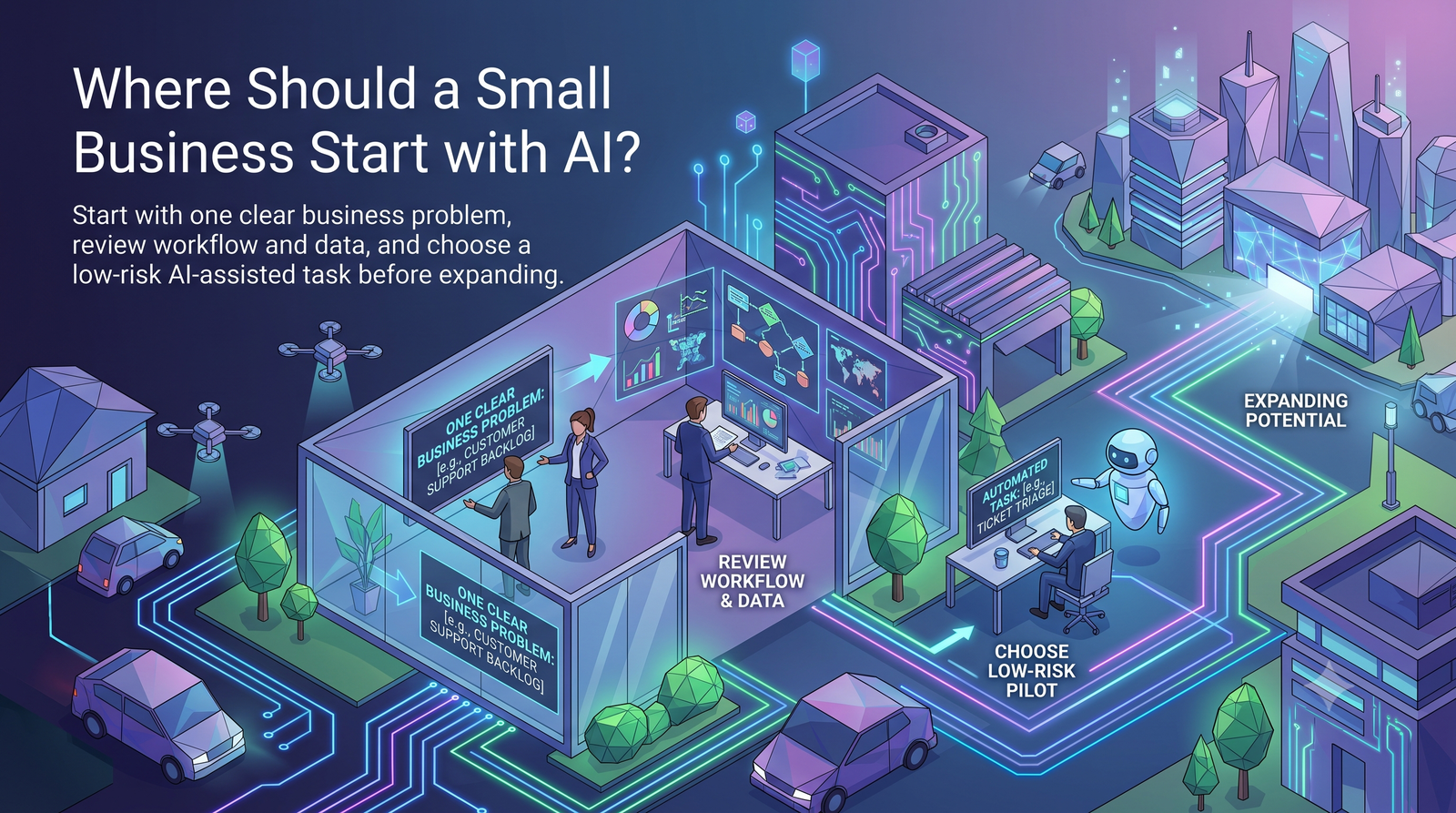
Start with one clear business problem, review workflow and data, and choose a low-risk AI-assisted task before expanding.
Updated:
AI for Small Business
What is the direct answer?
A small business should start with AI by choosing one narrow pilot workflow with a clear input, clear output, low operational risk and a short test period. Human review should stay in place until the business knows what worked and what the next measurable step should be.
What are the key takeaways?
- Choose one narrow workflow instead of a company-wide AI rollout.
- Define the input, output, review step and pilot period before testing.
- Use a measurable next step before expanding the AI workflow.
What does this look like in a small business?
A Shopify store could run a two-week pilot where AI summarizes product enquiries from a standard inbox and suggests follow-up categories. Staff review every suggestion, then decide whether the next step is better tagging, reply drafts or workflow automation.
AI is discussed in almost every industry, but many small-business owners still face the same practical question: where should we begin?
The most useful starting point is usually not a new tool. It is one clear business problem that happens frequently, consumes time, creates errors, or delays customer service.
Start with the problem
Instead of asking which AI platform to buy, ask which part of the business is taking too much time or producing inconsistent results.
Possible starting points include handling similar customer enquiries, preparing recurring reports, organizing form or document information, drafting standard content, summarizing meetings, and following up with leads.
The clearer the problem, the easier it becomes to decide whether AI is appropriate.
Review the current workflow
This often reveals that the main issue is not the absence of AI. It may be duplicated data entry, unclear ownership, poor information storage, or too many disconnected tools.
AI should support a clear workflow, not hide a weak one.
- where the information comes from
- who handles each step
- which tools are involved
- where delays happen
- what requires judgment
- what result is expected
Check the data
AI output depends heavily on the information it receives. Before implementation, confirm that the required data is available, accurate, current, consistently stored, and appropriate to use.
The business should also identify whether the workflow contains private or sensitive information and who is allowed to access it.
Choose a low-risk first use case
Avoid beginning with legal advice, final pricing, sensitive complaints, employee assessment, or fully automated public communication.
- drafting a reply for staff approval
- summarizing internal notes
- categorizing incoming enquiries
- extracting selected information from a document
- preparing a content draft
- generating an internal checklist
Define success
A small AI project should have a clear purpose. Success might mean fewer manual steps, faster preparation, more consistent formatting, easier access to information, or fewer missed follow-ups.
Without a simple measure, it is difficult to know whether the new workflow is genuinely useful.
Keep human review
AI can misunderstand context or produce incorrect output. The first implementation should normally include human approval before anything is sent to a customer, published publicly, or used for an important decision.
The workflow should define who reviews the output, what must be checked, and when the process should return to manual handling.
A practical five-step framework
Dpixel helps small businesses assess workflows, identify realistic AI use cases, and plan implementation around current operations rather than technology trends.
- Select one repeated business problem.
- Document the current workflow.
- Check the quality and sensitivity of the required data.
- Test one low-risk AI-assisted task.
- Review the result before expanding.
FAQ
Does a small business need a full AI strategy before testing anything?
Not necessarily. A focused pilot with a clear objective, defined data, responsible review, and a simple success measure is usually enough to begin.
Should a business train its own AI model first?
Usually not. Most small businesses should first assess existing tools and APIs before considering custom model development.
Should AI output be sent directly to customers?
Important customer communication should normally be reviewed by a person, especially during the early stages of implementation.
Related reading
AI Strategy
When Should a Small Business Adopt AI?
AI should solve a clear business problem. Learn when small businesses should explore AI, when to wait, and how to start with a low-risk pilot.
AI Automation
How AI Automation Can Reduce Repetitive Work for Small Businesses
Practical AI automation can reduce repeated manual work when it supports a clear workflow and keeps people in control.
Next step
Want to know which workflows are worth automating?
Send an enquiry. dPixeL can help clarify the problem, map the workflow and identify a practical next step.