How to Build a Practical Digital Improvement Plan for a Small Business
Small businesses do not need to transform everything at once. Learn how to prioritize problems, choose a focused pilot, and build a measurable digital improvement plan.
Updated:
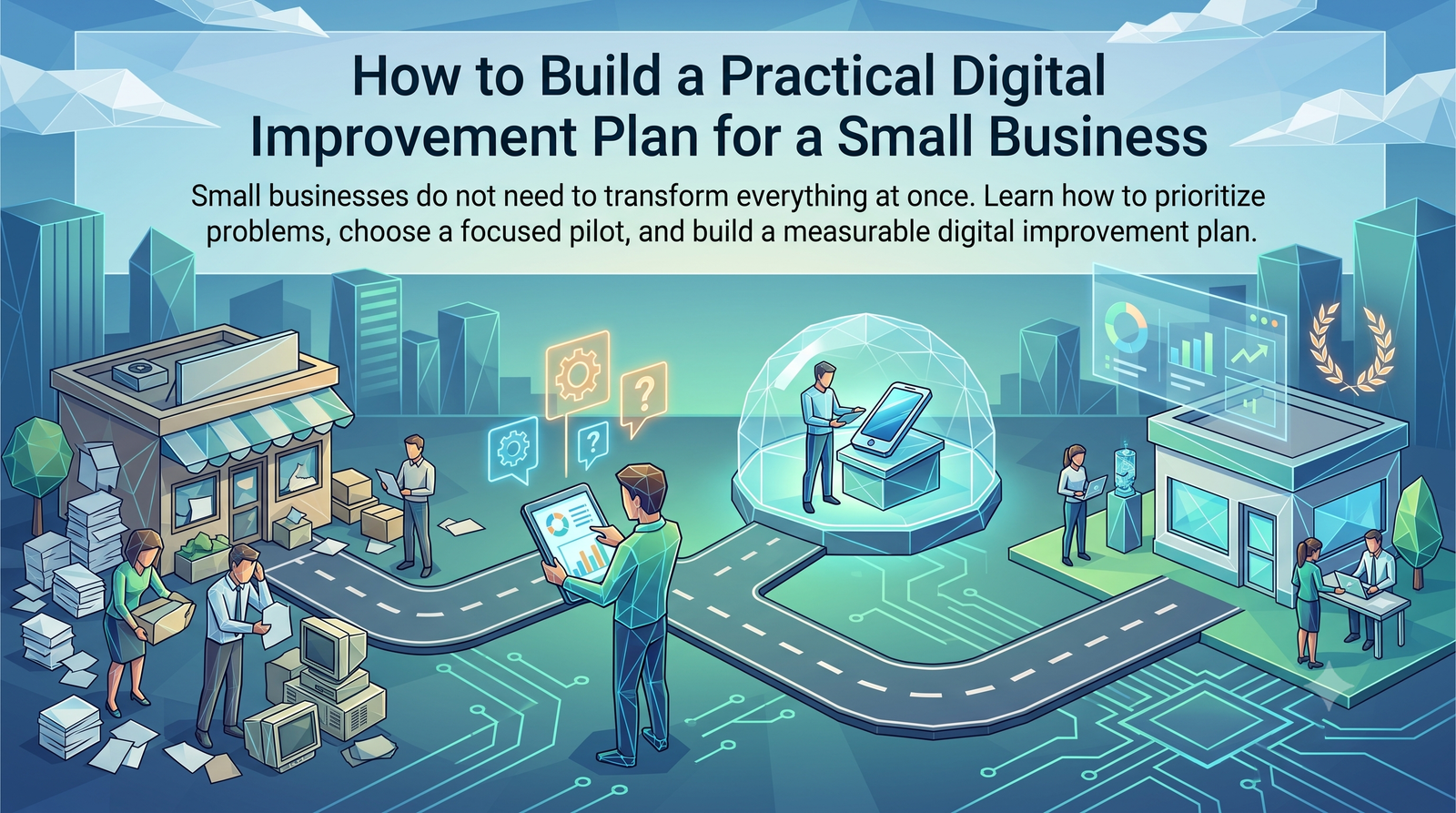
Website / Customer Enquiry / Digital Operations
What is the direct answer?
A practical digital improvement plan should connect the website, workflow, customer follow-up, measurement and maintenance. The goal is to choose a few improvements that the business can actually operate.
What are the key takeaways?
- A plan should match the team's size, budget and maintenance ability.
- Website and workflow decisions should be connected.
- Measurement helps decide what to improve next.
What does this look like in a small business?
A small professional service firm may prioritize clearer service pages, a better enquiry form and a follow-up checklist before investing in a larger platform.
Small businesses often face several problems at the same time. The website may need improvement, customer follow-up may be inconsistent, information may be scattered, staff may repeat the same work, and the company may be unsure whether AI is appropriate.
Buying a new tool for every problem quickly creates more accounts, more fees, and more complexity.
Effective digital improvement is not a one-time transformation. It is a process of setting clear priorities.
Step 1: List the business problems
Begin with the problems rather than the tools. Examples include customer enquiries being missed, websites not generating useful leads, repeated data organization, inconsistent quotation follow-up, repeated online-store questions, or teams unable to find the latest document version.
The problem should be specific enough to observe and measure.
Step 2: Assess business impact
High-impact problems with a manageable implementation effort usually deserve attention first.
- impact on revenue or customers
- time consumed each week
- risk of errors or omissions
- number of employees affected
- cost and difficulty of improvement
- whether another project must be completed first
Step 3: Choose the right type of solution
The same business problem may have several possible solutions: removing an unnecessary step, creating an SOP, clarifying responsibilities, improving the website or form, integrating existing software, adding workflow automation, using AI assistance, or replacing an unsuitable system.
Technology consulting should compare these options rather than assume the newest tool is automatically best.
Step 4: Create a focused pilot
After the pilot, the business should review actual usage and results before expanding.
- the problem being solved
- the responsible person
- the implementation period
- the expected outcome
- risks that require review
- success and stop conditions
Step 5: Establish a continuous improvement cycle
Digital operations are not a one-time project. The company should regularly review which workflows still waste time, whether new tools are being used, whether new repetitive work has appeared, whether the customer journey is clearer, and whether system costs remain reasonable.
Dpixel does not simply sell websites, AI, or automation. The role is to identify the problem, compare solutions, implement the right improvement, and keep technology aligned with business objectives.
FAQ
Does digital improvement require a large budget?
Not necessarily. Solving one specific problem is usually easier to control than launching a large transformation project.
Should a business improve the website or internal workflow first?
It depends on the primary business problem. A lack of enquiries may make the website more urgent, while heavy workload and operational confusion may make internal processes the priority.
How can a business avoid buying too many tools?
Every tool should have a defined problem, owner, workflow, and success measure.
Related reading
Digital Operations
How Your Website, Workflow, and Customer Follow-up Affect Business Efficiency
A website, internal workflow, and customer follow-up form one connected system. Learn where gaps reduce efficiency and enquiry quality.
Website Conversion
Why does your website get visitors but no customer inquiries?
If a website has traffic but no inquiries, the issue may be messaging, trust, calls to action, mobile experience or speed.
Lead Follow-up
How to Stop Losing Customer Enquiries Because of Slow Follow-up
Local service businesses often lose enquiries because responses are delayed. Learn how confirmation, assignment, tracking, and follow-up workflows can reduce missed opportunities.
Next step
Want to know which workflows are worth automating?
Send an enquiry. dPixeL can help clarify the problem, map the workflow and identify a practical next step.